
Outcomes
We measure success by what leadership can see, trust, and sustain — not short-term improvements that fade under pressure.
Outcomes Define Control
Healthcare organizations do not fail from lack of effort. They fail from lack of operational control.
Healthcare operations often appear productive while remaining structurally fragile. High claim volume, busy staff, and full schedules can mask deeper operational risk. Activity is not control, and effort does not equal performance.
Without outcome-driven structures, improvements depend on individual vigilance rather than system design. When key staff leave, payer rules change, or audit scrutiny increases, those gains quickly erode.
We define success through outcomes that persist under pressure – across scale, staff turnover, payer behavior, and regulatory change. These outcomes provide leadership with objective visibility into financial health, workflow integrity, and compliance posture.
Our role is not to optimize isolated tasks, but to build operational systems that perform predictably regardless of specialty, care model, or organizational complexity.
Outcomes Are Designed — Not Assumed
Sustainable outcomes are not just the result of individual effort or temporary optimization. They are the product of a deliberate systems design where accountability, data visibility, and operational ownership are structurally embedded.
Our work focuses on building operational environments where performance does not depend on heroics, memory, or constant oversight — but on repeatable execution.
Operational Stability
Outcome Indicators:
Reduced rework loops
Lower handoff friction
Fewer escalation events
Financial Predictability
Outcome Indicators:
Tighter A/R aging bands
Improved first-pass yield
Faster time-to-collection
Compliance Control
Outcome Indicators:
Fewer documentation-driven denials
Lower audit disruption
Clear defensibility under review
What Changes When Outcomes Are Aligned
When outcomes are clearly defined and structurally supported, organizations experience a measurable shift, not just in metrics, but in how work feels day to day.
The result is less noise, fewer emergencies, and more time spent managing forward rather than correcting backward.
Reduced Rework and Denial Cycles
Clear upstream controls reduce downstream correction. When eligibility, authorization, and documentation requirements are aligned to payer logic at the point of care, denial volume drops, and the remaining denials become faster to resolve.
Clear Ownership Across Workflows
Ambiguity creates delays.
Defined responsibility at each operational handoff ensures issues are resolved at the correct point, rather than escalated, duplicated, or deferred.
Predictable Revenue Patterns
Revenue volatility often reflects process inconsistency rather than payer behavior. Aligned workflows stabilize submission timing, follow-up cadence, and collection velocity, enabling leadership to plan rather than react.
Lower Compliance Anxiety
When compliance is operationalized, staff stop guessing. Teams work with confidence knowing documentation, timing, and billing standards are embedded into routine workflows, not enforced retroactively.
Visible & Manageable Signals
Stable outcomes create a different operating environment. Leadership stops chasing fragmented updates and starts managing from reliable signals.
We establish visibility into operational integrity, financial performance, and compliance posture through defined indicators that reflect real workflow health and not surface-level activity.
The goal is not reporting for the sake of it. The goal is transparency and leadership efficiency: fewer surprises, faster decisions, and a system that stays stable when volume, staffing, and payer requirements change.
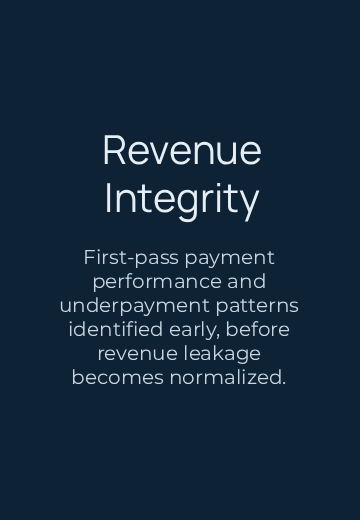
Revenue signals matching cash reality, not assumptions
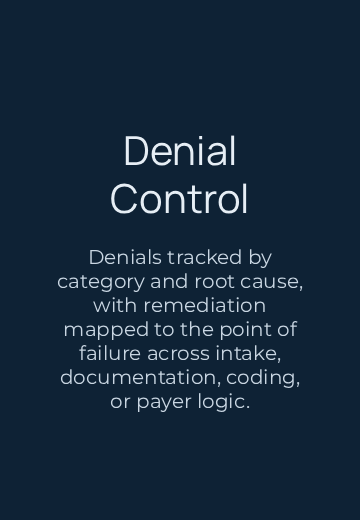
Denial patterns categorized by root cause, not symptom
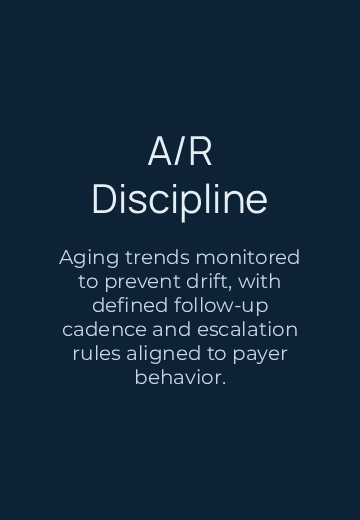
A/R health staying within defined bands
Authorization integrity tracked before downstream damage
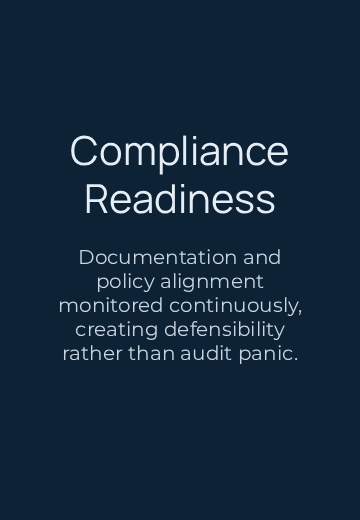
Documentation risk identified before audit exposure grows
How These Signals Vary Across Environments
Outcomes are not abstract. They are shaped by how care is delivered, documented, staffed, and reimbursed. The environments below are where outcome design makes the difference between stability and constant remediation. At WSA Healthcare, we appreciate these subtleties, and allow them to drive our outcomes-oriented approach towards practice management.
Visit Specialties & Care Models for further detail.
Independent Physician Practices
Outcome pressure:
- high payer variability with inconsistent adjudication behavior
- limited internal redundancy across billing, compliance, and follow-up functions
- leadership dependence on informal knowledge rather than documented process
- revenue sensitivity to staff absence or turnover
Stability signals:
predictable cash flow without daily leadership intervention
clean-claim performance sustained across payers, not just top contracts
A/R aging controlled within defined bands
issues resolved at the process level rather than through individual escalation
Specialty Practices
Outcome pressure:
specialty-specific coding and documentation precision requirements
high dollar claims increasing scrutiny and audit sensitivity
dependencies between scheduling, authorization, clinical notes, and coding
revenue volatility caused by small upstream failures
Stability signals:
- high clean-claim rates sustained across complex cases
- authorization integrity verified before downstream impact
- denials traced to precise failure points, not generalized “billing issues”
- revenue predictability even with high-value encounters
Home Health & Post-Acute Care
Outcome pressure:
time-sensitive documentation tied to episodic billing rules
high audit exposure driven by eligibility, visit timing, and clinical alignment
complex payer logic across Medicare, Medicaid, and managed care
revenue delays amplified by incomplete or late documentation
Stability signals:
clean episodes submitted within defined timeframes
documentation defensible under audit, not just payable
A/R aging controlled despite episodic reimbursement cycles
denials resolved at the root cause (clinical, timing, or payer logic)
Virtual Care (Telehealth, Remote Monitoring, Hybrid Models)
Outcome pressure:
payer policy variability by modality, geography, and provider type
documentation standards still evolving across payers
risk of reimbursement changes without operational awareness
technology-driven workflows without reimbursement guardrails
Stability signals:
billing aligned to current payer and regulatory requirements
documentation supports both reimbursement and compliance
revenue remains stable despite payer or policy changes
operational controls adapt faster than reimbursement shifts
New Practices & Growth-Stage Organizations
Outcome pressure:
rapid volume growth outpacing workflow maturity
incomplete front-end controls during early expansion
revenue and compliance risk masked by short-term growth
technology adoption without operational governance
Stability signals:
outcomes that scale without breaking controls
early detection of leakage before it compounds
clear ownership across intake, documentation, billing, and follow-up
growth supported by systems, not heroic effort
Assisted Living, Skilled Nursing & Memory Care
Outcome pressure:
- highly regulated documentation with facility-level accountability
- revenue dependency on interdisciplinary coordination (clinical, MDS, billing)
- high audit exposure tied to medical necessity, timing, and level-of-care determinations
- staffing variability impacting documentation completeness and timeliness
Stability signals:
documentation supports reimbursement and regulatory review
claims withstand payer scrutiny without retrospective remediation
revenue remains predictable despite staffing turnover
compliance risk identified early, not during audits or recoupments
Outcomes Are Only Valuable If They Hold
Stability is designed, not maintained through constant intervention.
Many organizations achieve short-term improvements – after audits, leadership changes, or system upgrades – only to regress once attention shifts.
Outcomes fail when they depend on individual effort rather than operational structure.
Our work focuses on embedding outcomes into the way the organization operates: defined ownership, controlled workflows, and monitored signals that persist through staff turnover, payer change, and regulatory pressure.
The goal is not optimization for a quarter – it’s operational control that leadership can rely on without constant escalation.
Every engagement begins with understanding where outcomes are currently fragile, where risk is accumulating, and which controls will create stability without over-engineering the operation.