
Specialties & Care Models
Healthcare operations are shaped by clinical specialty, care delivery model, regulatory exposure, and reimbursement structure. We support healthcare organizations across diverse care environments, each with distinct operational, compliance, and revenue dynamics.
Why Healthcare Operations Cannot Be Generic
Healthcare operations do not scale uniformly across specialties or care models. A workflow that functions effectively in primary care may break down entirely in specialty care, and will definitely suffer in senior living environments. Documentation standards, staffing structures, payer behavior, and audit exposure vary significantly based on how care is delivered.
Specialty care continues to grow as a driver of total healthcare spend. According to recent analyses, specialty care accounts for an increasing share of commercial and Medicare total cost of care, with direct specialty spending expanding faster than other segments. This makes specialty-specific operational focus a strategic imperative.
Operational challenges often appear similar on the surface – delayed payments, denials, staffing strain – but their root causes are frequently specialty-specific. Treating these issues generically introduces risk rather than resolving it.
Our work begins with understanding the operational realities unique to each specialty and care model. This allows us to design revenue cycle workflows, compliance controls, and operational support structures that align with how care is actually delivered, documented, and reimbursed.
Operational Support Built Around How Care Is Delivered
Across specialties and care models, our work consistently focuses on three outcomes: operational stability, financial predictability, and compliance control. While execution differs by specialty, the underlying principles remain disciplined and structured.
We work alongside clinical and administrative leadership to assess operational gaps, identify revenue leakage points, and stabilize workflows that directly affect cash flow, staffing efficiency, and audit exposure. This includes aligning front-end processes such as eligibility and authorization with downstream billing and documentation workflows, ensuring continuity rather than fragmentation.
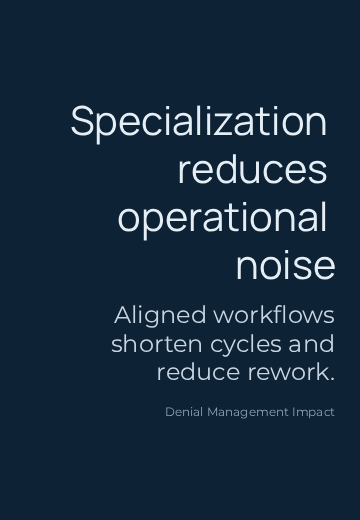
Our teams support practices through defined processes rather than ad-hoc task handling. This allows leadership to regain visibility, reduce operational noise, and make informed decisions grounded in reliable data.
Specialties & Care Models We Serve
Core Practice Types
Primary Care & Internal Medicine
High patient volume, chronic condition management, preventive care metrics, and complex payer mixes require tightly coordinated front-desk, documentation, and billing workflows. Operational success depends on visit throughput, accurate coding, and consistent follow-up.
Multi-Specialty Groups
Cross-specialty variability introduces complexity in documentation standards, coding practices, and revenue oversight. Centralized billing without standardized workflows often creates hidden inefficiencies that surface as delayed collections or reporting blind spots
Specialty Practices
Cardiology, orthopedics, gastroenterology, neurology, and similar specialties face higher documentation complexity, modifier usage, authorization sensitivity, and payer scrutiny. Revenue stability depends on precision and workflow discipline rather than volume alone.
Care Delivery Models
Home Health & Hospice
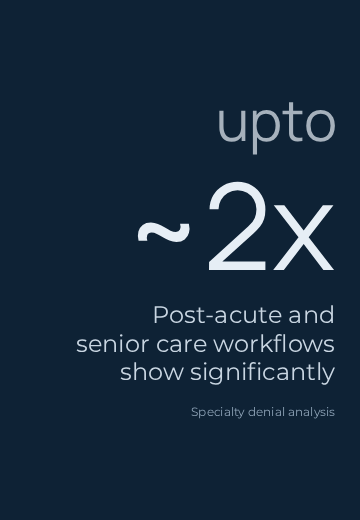
Episode-based reimbursement, OASIS documentation accuracy, PDGM sensitivity, and audit exposure require operational rigor. Minor documentation gaps can translate into significant revenue disruption or compliance risk.
Remote Care & Virtual Services
RPM, CCM, TCM, and telehealth programs demand accurate time tracking, documentation integrity, and evolving payer rule alignment. Operational success depends on coordination across clinical, administrative, and billing teams.
Long-Term Care & Senior Living
Assisted living, skilled nursing, and memory care environments introduce multi-facility oversight, layered billing structures, and heightened regulatory scrutiny. Centralized control and standardized workflows are critical to financial and operational clarity.
Lifecycle Based Support
New Practices & Startups
Early-stage practices face compounded risk across credentialing, payer enrollment, workflow design, and initial cash-flow stability. Decisions made in the first 90 days often determine long-term operational health.
What Changes When
Operations Are Aligned
Reduced rework and denial cycles
When workflows are aligned to the care model, documentation requirements are addressed upstream rather than corrected post-denial. This reduces preventable rework driven by missing modifiers, timing mismatches, or unsupported services.
In practice, organizations with specialty-aligned intake, documentation, and charge capture processes experience fewer repetitive corrections and shorter denial resolution cycles, particularly in high-risk environments.
Clear ownership across workflows
Misaligned operations often fail not due to lack of effort, but lack of ownership. When responsibilities are unclear across front desk, clinical teams, billing, and follow-up, issues are passed downstream until they surface as denials or audits.
Aligned operations define accountability at each stage—eligibility, authorization, documentation, coding, billing, and follow-up—so exceptions are addressed at the source rather than escalated after the fact.
Predictable revenue patterns
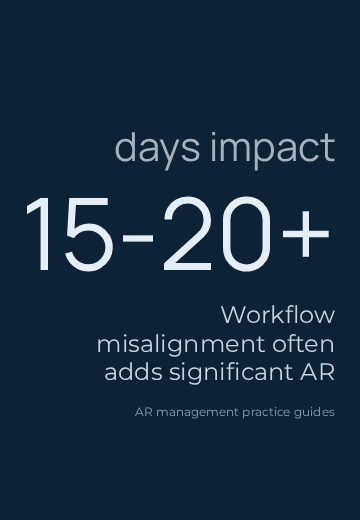
Revenue volatility is frequently a symptom of workflow inconsistency rather than payer behavior alone. When processes are standardized around how care is delivered and billed, claim timing, payment variance, and A/R aging stabilize.
Practices operating with aligned workflows are better positioned to forecast cash flow, identify outliers early, and distinguish true payer issues from internal process breakdowns—especially in multi-payer or multi-location environments.
Lower compliance anxiety
Compliance risk increases when operational shortcuts are used to compensate for misaligned systems. Specialty-aware workflows reduce reliance on workarounds by embedding documentation and billing requirements into daily operations.
This approach not only reduces audit exposure but also shifts compliance from a reactive function to a controlled operational discipline—particularly critical in post-acute, senior care, and program-based billing environments.
How We Measure Success
While operational goals differ by specialty, success is consistently measured through defined performance indicators rather than assumptions. These metrics provide leadership with visibility into financial health, workflow effectiveness, and compliance posture.
Clean-claim submission rates
Achieved through front-end eligibility alignment, specialty-specific documentation controls, and payer rule mapping.
Accounts receivable aging distribution
Maintained by tightening authorization-to-billing handoffs and resolving denial drivers at the root level.
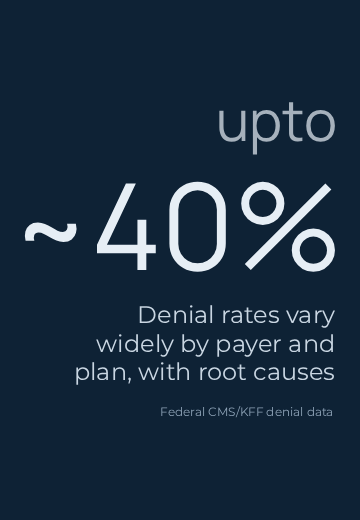
DENIAL RATES BY CATEGORY AND CAUSE
Driven by denial categorization, payer-specific remediation, and documentation feedback loops.
PRIOR AUTHORIZATION APPROVAL RATE
Supported by specialty-aware intake workflows and authorization tracking tied to scheduling.
FIRST-PASS
YIELD
Percentage of claims paid without resubmission, reflecting documentation accuracy, coding alignment, and payer-specific rule adherence.
Time-to-collection trends
Achieved by aligning front-end accuracy with downstream billing and follow-up processes.
Each specialty and care model we support is backed by structured services across revenue cycle management, practice operations, compliance support, and staffing continuity. Services are configured based on specialty-specific risk, scale, and regulatory exposure rather than a fixed engagement model.
This allows us to support organizations at different stages of maturity while maintaining operational consistency and accountability.